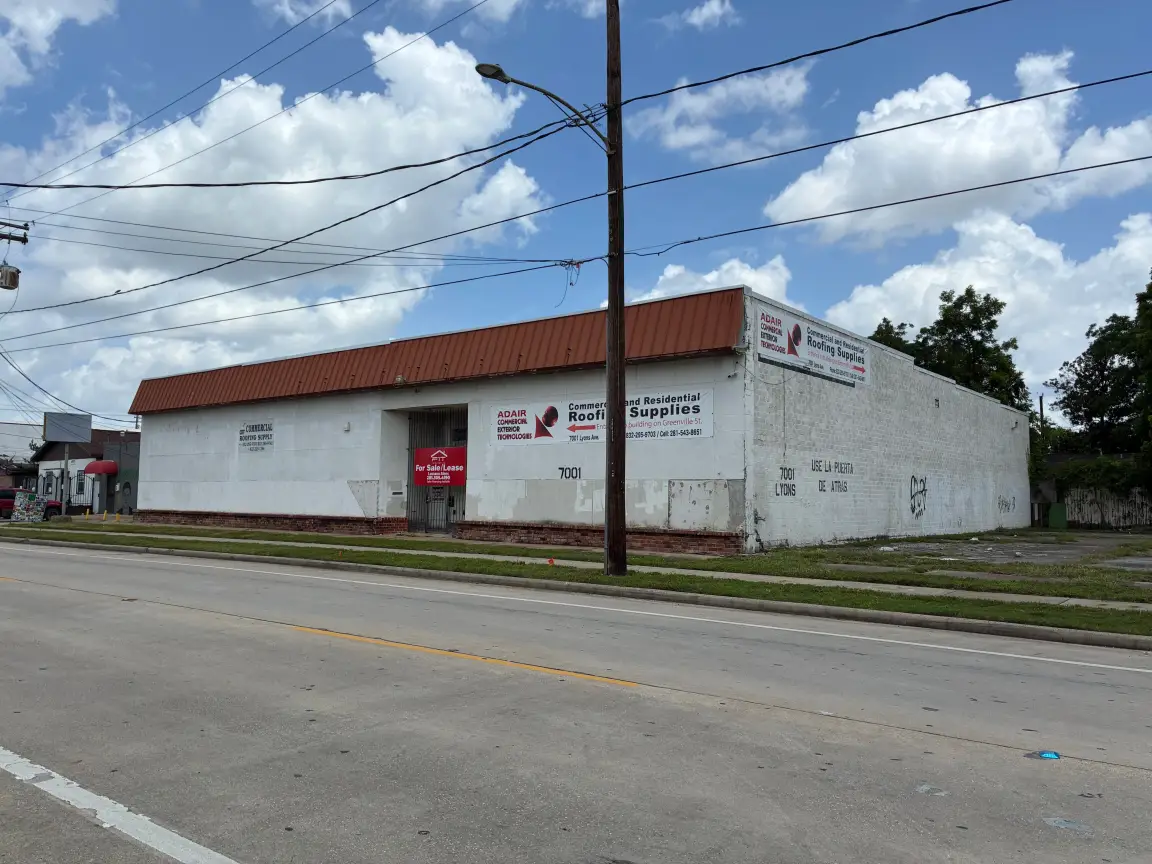

The roof needs work. The parking lot has seen better days. The HVAC system is getting older, and you’ve been putting off a list of repairs because you’re not sure how much longer you want to own the building.
Or maybe the property isn’t a building at all.
Perhaps you own a vacant commercial lot in Houston that needs clearing, drainage improvements, or utility connections before someone can develop it.
Either way, you’re facing a decision.
Do you spend more money getting the property ready to sell?
Or do you find a buyer who’s willing to take it in its current condition?
For many commercial property owners, the second option is worth exploring.
Can you sell commercial property as-is in Houston?
Yes. You can sell commercial property as-is in Houston, Texas, if you find a buyer willing to accept its condition under the terms of a purchase agreement. An as-is sale may allow you to avoid making repairs or renovations before closing, but buyers can still request inspections, review environmental conditions, investigate title, and negotiate contingencies.
The important part is understanding what an as-is sale actually involves.
It isn’t a way to avoid every responsibility. And it doesn’t guarantee a fast closing or a particular price.
But it can be a practical alternative when you’re ready to sell a commercial property without investing more money in it.
Here’s how to approach the process, what buyers will want to know, and how to decide whether selling as-is makes financial sense.
1. What Does Selling Commercial Property As-Is Actually Mean?
When you sell commercial property as-is, you’re generally offering the property in its existing condition rather than agreeing to complete repairs or improvements before closing.
For example, suppose you own a small retail building in Houston.
The roof is aging. Several interior spaces need updates. The parking lot could use resurfacing.
Instead of paying contractors to address those items, you offer the building in its current condition.
A buyer might agree to purchase it, knowing that those improvements will become their responsibility after closing.
But there’s an important distinction.
As-is describes the condition in which the buyer agrees to accept the property. It does not automatically eliminate the buyer’s right to investigate that condition.
Depending on the contract, the buyer may still:
- Inspect the building and its systems
- Review environmental conditions
- Examine leases and financial records
- Obtain a survey
- Review title and easements
- Investigate code or permitting concerns
- Negotiate a due-diligence period
- Terminate the agreement under specified circumstances
The exact rights and obligations depend on the purchase agreement and applicable law.
That’s why the contract matters just as much as the words as-is in your listing.
2. What Types of Commercial Property Can Be Sold As-Is?
As-is transactions aren’t limited to abandoned or distressed buildings.
Owners may explore this approach for properties in a wide range of conditions.
| Property Type | Why an Owner Might Consider an As-Is Sale |
|---|---|
| Vacant retail building | Deferred maintenance, outdated interiors, prolonged vacancy |
| Office building | Aging systems, needed renovations, declining occupancy |
| Warehouse | Roof issues, loading-area repairs, outdated building features |
| Industrial property | Specialized improvements, maintenance needs, environmental questions |
| Shopping center | Tenant turnover, capital improvements, parking lot repairs |
| Mixed-use building | Multiple repair needs or complicated tenant arrangements |
| Vacant commercial land | Clearing, access, utilities, drainage, or site-preparation costs |
| Underused commercial property | The owner no longer wants to invest in repositioning the asset |
The buyer pool will vary by property type.
A commercial developer may be interested in a site for redevelopment.
An investor may want an income-producing property that needs improvements.
A neighboring business may see value in an adjoining parcel.
A direct land buyer may consider certain vacant commercial lots.
The important thing is to find buyers whose acquisition criteria match the property.
Does 1800LOTS buy commercial buildings as-is?
1800LOTS is a Houston-based buyer of vacant and undeveloped land, including select commercial land.
Owners of vacant commercial parcels can explore the company’s Houston land-buying service.
For improved commercial buildings, such as offices, warehouses, or retail centers, acquisition eligibility should be confirmed directly before assuming the company can purchase the asset.
3. Why Do Houston Owners Choose to Sell Commercial Property As-Is?
Usually, the decision comes down to a practical question:
Is putting more money into this property worth it?
There are several reasons an owner may decide the answer is no.
The property needs expensive repairs
Commercial improvements can be costly.
A roof replacement, major HVAC repair, electrical upgrade, or parking lot reconstruction may require a significant investment.
If you’re planning to sell anyway, you may not want to take on that expense.
The building has been vacant
An empty commercial building can continue generating expenses without producing rental income.
Depending on the property, those costs may include taxes, insurance, utilities, maintenance, security, and financing.
The longer the building remains vacant, the more those costs can accumulate.
The property no longer fits your plans
Maybe you’re retiring.
Maybe you’re closing a business.
Maybe you’ve decided to focus on another investment.
Or perhaps you inherited a property you don’t want to manage.
You may simply prefer to sell rather than spend additional time overseeing improvements.
The property has redevelopment potential
Some buyers aren’t interested in preserving the existing improvements.
They may want to renovate extensively, change the use where permitted, or redevelop the site.
In those cases, spending money on cosmetic updates may provide little benefit.
The key consideration isn’t whether the property could look better. It’s whether the improvements would produce a better financial outcome for you.
4. What Problems Will Buyers Accept in an As-Is Commercial Sale?
There’s no universal answer.
Different buyers tolerate different levels of risk.
An investor who specializes in renovations may consider a building with deferred maintenance.
A developer may evaluate a parcel with significant site-preparation needs.
Another buyer may reject the same property because the costs or uncertainty don’t fit its plans.
Here are some common conditions that may arise.
| Property Condition | What a Buyer May Consider |
|---|---|
| Aging roof | Remaining useful life and replacement cost |
| Outdated HVAC | Repair or replacement expenses |
| Interior damage | Renovation budget and future tenant requirements |
| Vacant building | Security, maintenance, leasing costs, and time |
| Parking lot deterioration | Repair expenses and applicable requirements |
| Unfinished improvements | Permits, inspections, and completion costs |
| Missing utilities on land | Connection feasibility and infrastructure expense |
| Drainage problems | Engineering requirements and site costs |
| Environmental concerns | Investigation, liability, and potential remediation |
| Title or access issues | Whether the property can be transferred and used as intended |
Some issues affect price.
Others can prevent a buyer from proceeding until more information is available.
For example, a buyer may be comfortable replacing an old roof.
But an unresolved ownership dispute or an unknown environmental condition may require additional work before the buyer can make a reliable decision.
An as-is sale transfers agreed property-condition responsibilities. It doesn’t automatically resolve every legal or transactional obstacle.
5. Do You Have to Disclose Problems When Selling Commercial Property As-Is in Texas?
This is an important question.
An as-is provision should not be treated as permission to conceal material facts or make false statements.
Texas commercial real estate transactions can involve different disclosure requirements and contractual obligations depending on the property and circumstances.
The residential seller’s disclosure rules commonly discussed in Texas real estate do not automatically apply to every commercial transaction in the same way.
However, that doesn’t mean commercial sellers have no legal responsibilities.
Fraud, misrepresentation, contractual representations, and other applicable legal requirements may still matter.
The Texas Property Code provides statutory context for Texas real property transactions, although the applicability of particular provisions depends on the transaction.
A practical approach
Before marketing the property, make a list of known issues.
For example:
- Existing roof leaks
- Major mechanical failures
- Known drainage problems
- Outstanding notices or violations
- Environmental reports
- Unresolved access questions
- Material lease or occupancy issues
Then discuss with a qualified Texas commercial real estate attorney what must be disclosed, what documents should be provided, and how the contract should address the property’s condition.
You don’t need to guarantee that a property is perfect.
You do need to avoid presenting inaccurate information as fact.
6. Should You Make Repairs Before Selling Commercial Property As-Is?
Not necessarily.
But don’t decide based only on the size of the repair estimate.
The better question is whether completing the work would improve your net proceeds enough to justify the expense and delay.
Consider a hypothetical example
Suppose you own a vacant commercial building.
A contractor estimates that necessary improvements would cost $80,000.
You believe those improvements might increase the eventual selling price by $100,000.
At first glance, spending $80,000 to gain $100,000 sounds worthwhile.
But you also need to consider:
- Additional holding expenses
- Project management time
- Permit or inspection costs
- Potential cost overruns
- Whether the improved property would actually sell for the expected amount
If the project takes several months and creates additional expenses, the financial advantage may shrink or disappear.
Compare two scenarios
Scenario A: Improve before selling
Estimated net proceeds after the eventual sale, less improvement costs, carrying expenses, and other selling costs.
Scenario B: Sell as-is
Estimated net proceeds from an actual as-is offer, less applicable transaction costs.
The comparison should use supportable assumptions, not an optimistic renovated asking price.
Repairs that may be worth considering
Some relatively modest work can make a property easier to inspect or evaluate.
For example:
- Removing hazardous debris through appropriate professionals
- Securing an unsafe entry
- Addressing a specific issue required for an agreed transaction
- Providing access for inspections
- Organizing existing property documentation
But even small improvements should be evaluated in context.
A buyer planning extensive redevelopment may place little value on cosmetic work.
Don’t renovate for an imaginary buyer. Understand the likely buyer before deciding what to repair.
7. How Do You Price Commercial Property for an As-Is Sale?
This is where many sellers struggle.
You may know what the property would be worth in excellent condition.
You may know how much you originally paid.
You may also have a number in mind that would make selling feel worthwhile.
But an as-is buyer is evaluating the property that exists today.
And different commercial assets require different valuation methods.
Income-producing buildings
For an occupied property, buyers may examine:
- Net operating income
- Rent rolls
- Lease terms
- Occupancy
- Operating expenses
- Comparable sales
- Capitalization rates
- Deferred maintenance
- Future capital expenditures
Vacant buildings
For a vacant building, buyers may place more weight on:
- Comparable sales
- Physical condition
- Renovation costs
- Leasing potential
- Carrying expenses
- Redevelopment possibilities
Vacant commercial land
For commercial land, buyers may evaluate:
- Parcel size and shape
- Location and road frontage
- Legal access
- Utilities
- Flood and drainage conditions
- Restrictions
- Development feasibility
- Site-preparation expenses
The Harris Central Appraisal District can provide property records and appraisal information for properties within its jurisdiction.
However, an appraisal-district value is not necessarily the same as current market value or the amount a buyer will offer.
Why as-is offers may be lower
A buyer may account for repairs, due diligence, future holding costs, transaction expenses, and investment risk.
That doesn’t mean every as-is offer is unreasonable.
It means you need to understand how the buyer arrived at the number and compare it with credible market evidence.
For commercial land, see our guide to factors cash buyers consider when evaluating land in Houston.
8. How to Sell Commercial Property As-Is in Houston: Step by Step
The process can vary, but these eight steps provide a practical framework.
Step 1: Identify the property and its current condition
Gather basic information about the asset.
Include the address, parcel identification, land and building size, occupancy status, and known issues.
Don’t try to make the property sound better than it is.
Accurate information helps buyers decide whether the opportunity fits their criteria.
Step 2: Gather important documents
Depending on the property, buyers may request:
- Deed and ownership information
- Existing survey
- Title documents
- Lease agreements
- Rent roll
- Operating statements
- Property-tax information
- Maintenance records
- Environmental reports
- Existing permits or relevant notices
You may not have every document.
Start with what is available and identify what’s missing.
Step 3: Decide which selling method fits your goals
You can market the property through a commercial broker, pursue buyers directly, approach neighboring owners, or explore an investor sale.
If you want a broader comparison, read How to Sell Commercial Property Fast in Houston: 9 Options.
Step 4: Target buyers who purchase your property type
Don’t assume every commercial investor buys every kind of real estate.
A vacant-land buyer may not purchase an occupied office building.
An industrial investor may not want a small retail strip center.
Ask about acquisition criteria early.
Step 5: Request and evaluate offers
Compare more than the proposed price.
Look at the buyer’s funding, due-diligence rights, contingencies, closing expenses, and proposed timeline.
A high offer with broad cancellation rights may carry different risks from a lower offer with more limited conditions.
Step 6: Negotiate the as-is provisions
The contract should clearly address property condition, inspection rights, representations, closing obligations, and what happens if problems are discovered.
Have a qualified attorney review the agreement where appropriate.
Step 7: Complete due diligence and title work
Even when the buyer accepts the property’s physical condition, the transaction may require surveys, environmental investigation, title review, and other documentation.
Step 8: Close under the agreed terms
At closing, the necessary documents are executed, funds are handled through the appropriate closing process, and ownership is transferred according to the agreement.
Don’t assume a specific closing date until the relevant requirements have been reviewed.
9. Can You Sell a Commercial Building With Environmental Problems As-Is?
Potentially, but environmental concerns require special attention.
Certain commercial properties may have histories that warrant investigation.
Examples include some former industrial facilities, automotive businesses, and properties where hazardous materials may have been stored or used.
An as-is contract doesn’t automatically eliminate environmental liability.
Nor does it guarantee that a buyer will accept an unresolved contamination issue.
What buyers may investigate
A commercial buyer may request a Phase I environmental site assessment or other professional investigation, depending on the property and intended transaction.
The Texas Commission on Environmental Quality provides information about remediation programs and environmental cleanup in Texas.
For site-specific questions, consult qualified environmental and legal professionals.
What should you do as a seller?
If you have existing environmental reports, keep them organized and discuss how they should be handled in the transaction.
Don’t claim a property is free of contamination without an appropriate basis.
And don’t assume that selling as-is eliminates obligations associated with known environmental conditions.
The key takeaway: Environmental issues don’t always make a commercial sale impossible, but they can affect price, buyer eligibility, due diligence, and liability.
10. Is It Better to List the Property As-Is or Sell Directly to a Buyer?
Both can be reasonable.
The right choice depends on the asset, buyer demand, and your priorities.
| Consideration | Brokered As-Is Listing | Direct As-Is Sale |
|---|---|---|
| Buyer exposure | Potentially broad | Usually a specific buyer |
| Marketing | Broker-led | Often less extensive |
| Repairs | Negotiated | Negotiated |
| Inspections | Likely | Still likely |
| Commission | Depends on agreement | Depends on transaction |
| Financing | Depends on buyer | May be cash or otherwise structured |
| Closing timeline | Transaction-dependent | Transaction-dependent |
| Sale price | Market-driven | Offer-driven |
| Net proceeds | Must be calculated | Must be calculated |
A brokered sale may create competition among buyers.
A direct sale may reduce the work required to market the property.
But neither method guarantees a better result.
A higher offer may come with longer contingencies, more seller expenses, or greater closing uncertainty.
The best comparison is between realistic net proceeds, time, effort, and contractual risk.
11. How Do You Compare an As-Is Cash Offer With Renovating First?
Suppose you’re deciding between selling a commercial property today or investing in improvements.
Use this framework.
| Factor | Sell As-Is | Renovate Before Selling |
|---|---|---|
| Purchase price | Based on current condition | Based on expected improved condition |
| Upfront repair costs | Potentially lower | Potentially significant |
| Holding expenses | Depend on closing timeline | Include renovation period and sale period |
| Project management | Generally less | Greater |
| Cost-overrun risk | Generally lower for seller | Greater |
| Buyer pool | Condition-tolerant buyers | Potentially broader |
| Net proceeds | Based on actual offer and costs | Based on projected sale and total costs |
| Uncertainty | Transaction-dependent | Renovation and transaction-dependent |
Don’t rely only on the difference between the two expected selling prices.
Consider all the expenses needed to reach those prices.
For example, a renovated sale might generate a higher gross price while producing only a small improvement in net proceeds.
And if renovations take longer or cost more than planned, the expected advantage could disappear.
An as-is offer gives you another number to evaluate.
It doesn’t obligate you to accept it.
12. What Should You Ask an As-Is Commercial Property Buyer?
Before signing, ask questions that reveal how the transaction will actually work.
1. Do you purchase this type of commercial property?
Confirm whether the buyer handles vacant land, improved buildings, occupied properties, or distressed assets.
2. Are you purchasing with cash?
If the buyer claims to be paying cash, ask how funding can be verified.
3. What inspections will you require?
Find out whether the buyer intends to conduct physical, environmental, financial, or other due diligence.
4. Can the purchase price change after inspection?
Understand whether the offer is firm or subject to renegotiation.
5. Am I required to make any repairs?
Clarify the as-is provisions and any exceptions.
6. Who pays the closing costs?
Review title charges, survey costs, legal fees, commissions, and other expenses.
7. What happens if title problems arise?
Find out how title objections and unresolved issues are handled.
8. Can you assign the contract?
Understand whether another party may become the purchaser and who remains responsible for performance.
9. What is the proposed closing timeline?
Ask what could delay closing and whether the buyer’s deadlines are conditional.
10. What will I actually receive at closing?
Request an estimated net-proceeds calculation.
A serious buyer should be willing to explain the process clearly.
13. How Does an As-Is Sale Work for Vacant Commercial Land?
Commercial land is different from an improved commercial building.
There may be no roof, HVAC system, or tenants.
But the property can still have conditions that affect its marketability.
For example:
- The lot may need clearing
- Utilities may not be connected
- Access may require investigation
- Drainage conditions may affect development
- Easements may limit usable space
- Deed restrictions may affect intended uses
A direct land buyer may consider some of these issues when evaluating the parcel.
The buyer will generally want to understand the property’s location, characteristics, and potential use.
What if you own commercial land in Houston?
1800LOTS considers select commercial land and other vacant or undeveloped parcels.
You can learn more about the 1800LOTS selling process, review the frequently asked questions, or explore the Houston land-buying page.
Not every property will qualify.
And the company should confirm whether your specific parcel fits its buying criteria before any offer is assumed.
For owners of improved commercial buildings, eligibility should be confirmed separately.
Frequently Asked Questions About Selling Commercial Property As-Is in Houston
Can I sell commercial property as-is in Houston, Texas?
Yes. Commercial property can be sold in its current condition if the buyer and seller agree to appropriate contract terms. Inspections, title review, and other due diligence may still apply.
Do I have to repair my commercial building before selling it?
Not necessarily. Some buyers purchase commercial buildings that need repairs or renovations. The property’s condition can affect the price and buyer pool.
Can I sell a vacant commercial building as-is?
Potentially. Investors and other commercial buyers may consider vacant buildings, depending on location, condition, intended use, and financial requirements.
Can I sell commercial land without clearing it first?
Potentially. Some land buyers evaluate undeveloped or overgrown parcels in their existing condition. Clearing needs may influence the offer.
Does as-is mean the buyer cannot inspect the property?
No. Inspection and due-diligence rights depend on the contract. An as-is provision doesn’t automatically eliminate those rights.
Can I sell commercial property with code violations?
Potentially, but violations may affect buyer interest, contract terms, price, and closing requirements. Obtain property-specific legal and professional advice.
Can I sell commercial property with tenants?
Yes, depending on the property and transaction. Buyers may review leases, tenant rights, deposits, rent rolls, and other obligations.
Can I sell commercial property with an existing mortgage?
Potentially. Existing loans and liens generally need to be addressed at closing, subject to loan documents and the transaction structure.
Will an as-is buyer pay full market value?
Not necessarily. Buyers may account for repairs, risk, holding expenses, and other costs. Compare offers with relevant market evidence and estimated net proceeds.
Is selling as-is faster than renovating first?
It can be, because the seller may avoid completing improvements before marketing or closing. But due diligence, title issues, and other conditions can still cause delays.
Does 1800LOTS buy commercial property as-is?
1800LOTS considers vacant and undeveloped land, including select commercial land. Owners of improved commercial buildings should confirm directly whether their property is eligible.
Can I request an offer without agreeing to sell?
Yes. A no-obligation inquiry allows you to explore an offer without automatically committing to a transaction. Review any contract before signing.
You Don’t Have to Renovate Everything Before You Sell
Owning commercial property can be expensive.
Even when a building is vacant, the bills don’t necessarily stop.
And when repairs start adding up, it’s reasonable to question whether putting more money into the asset is the best decision.
You may be able to renovate and pursue a higher sale price.
You may be able to list the property in its current condition.
Or you may be able to find a buyer who wants to purchase it directly.
The important thing is to compare those options using realistic numbers.
What will the repairs cost?
How long will they take?
What will you spend while waiting?
And how much are you likely to keep after the sale?
If you own vacant commercial land in Houston, 1800LOTS may be an option worth exploring.
Learn more about how the company buys land or request a no-obligation offer.
If you own a commercial building, such as an office, warehouse, or retail property, contact the company to confirm whether that asset is within its current acquisition criteria.
You don’t have to make a decision based on frustration.
And you don’t have to assume that every repair needs to be completed before selling.
Start by understanding what your property is worth in its current condition.
Then choose the path that makes the most sense for your finances, your timeline, and what you want to do next.
This article is for general educational purposes and does not constitute legal, tax, environmental, engineering, investment, or property-valuation advice. Commercial real estate transactions depend on the specific property, applicable law, contract terms, and the parties involved. Consult qualified professionals about your circumstances.